

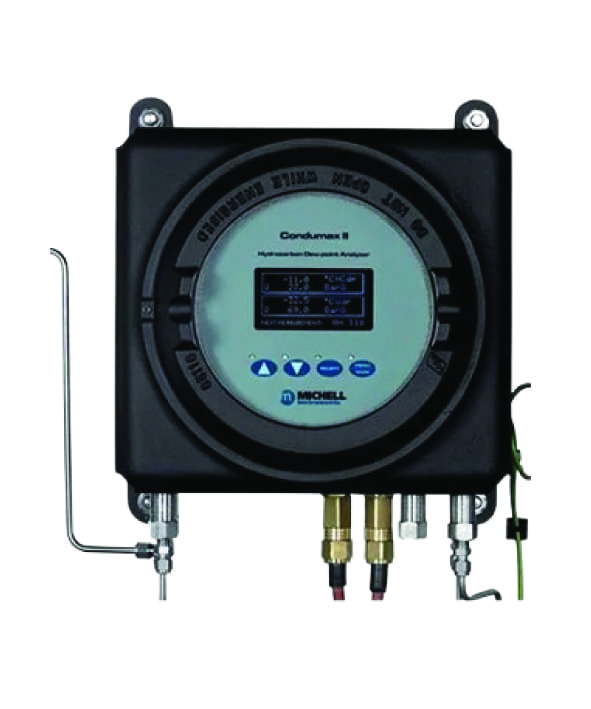
Product Overview
The Condumax II Hydrocarbon and Water Dew Point Analyzer is a fully automatic, continuous online analyzer for measurement of both hydrocarbon dew point and water dew point in natural gas and other process gases. It combines a hydrocarbon dew-point measurement cell with an optional water dew-point sensor in a single, explosion‑proof enclosure suitable for hazardous area installation.
Key Technical Specifications:
- Hydrocarbon Dew‑Point Measuring Technique: Dark Spot™ direct chilled‑mirror fixed sample analysis detecting condensate through optical measurement.
- Hydrocarbon Dew‑Point Accuracy: ±0.5 °C (single or multiple condensable component analysis).
- Hydrocarbon Sample Flow: ~0.03 m³/hr (0.5 Nl/min) – alarm standard.
- Hydrocarbon Operating Pressure: 15…100 barg.
- Water Dew‑Point Measuring Technique (Optional): Ceramic metal‑oxide moisture sensor.
- Water Dew‑Point Range: –100 to +20 °C (calibrated).
- Water Dew‑Point Accuracy: ±1 °C (–59 to +20 °C), ±2 °C (–100 to –60 °C).
- Resolution: 0.1 °C (both hydrocarbon and water dew point).
- Pressure Measurement Resolution: 0.1 MPa / barg and 1 psig units.
- Sample Gas Supply: Natural gas up to 100 barg (regulated).
- Enclosure: Explosion‑proof cast enclosure with internal heat for condensation protection, IP66 rating.
- Sample Connections: 1/8” or 1/4” NPT female for both hydrocarbon and water channels.
- Operating Environment: –20…+50 °C, up to 95 % RH.
- Power Supply: 90–260 V AC, 50/60 Hz (125 W main unit).
- Outputs: Modbus RTU, RS485, two user‑configurable 4–20 mA outputs.
- Certifications: IECEx, ATEX, UKCA, cQPSus, GOST Ex.
The optional water dew-point measurement channel uses the Michell Ceramic Moisture Sensor for water dew-point and moisture content outputs in units including °C, °F, lb/MMscf, mg/m³ and ppmV.
Description
Measurement Technology
The Condumax II employs two synergistic measurement methods:
Hydrocarbon Dew‑Point Measurement – Dark Spot™ Chilled Mirror:
The primary hydrocarbon dew-point channel uses the Dark Spot™ direct chilled‑mirror technique. In this method, a Peltier‑cooled mirror surface within the hydrocarbon sensor cell is progressively cooled under electronic control. When hydrocarbon condensate begins to form on the mirror, a secondary optical effect is detected as a reduction in scattered light intensity from a collimated beam reflected from the mirror’s surface. This point of optical change is used to define the hydrocarbon dew point directly, with objective and repeatable results.
The multi‑stage Peltier cooling system provides controlled cooling to achieve measurement depressions as low as Δ‑55 K beyond ambient analyzer temperature, ensuring accurate detection of condensate formation.
This direct optical condensation measurement is fundamental and primary, meaning there is no reliance on empirical correlations — the dew point is determined by the actual onset of condensation, making the technique inherently accurate and stable.
Water Dew‑Point Measurement – Ceramic Moisture Sensor (Optional):
For simultaneous water dew point analysis, Condumax II can accommodate an optional water dew‑point channel based on Michell’s Ceramic Metal‑Oxide Moisture Sensor. This sensor utilizes a ceramic metal‑oxide impedance sensing element that responds to changes in moisture content in the gas stream with measured impedance changes. These changes are converted into dew‑point values and moisture content in various units (°C, °F, ppmV, mg/m³, etc.), providing complementary data to hydrocarbon dew-point measurements.
Detailed Technical Specifications:
- Hydrocarbon Dew‑Point Measurement Frequency: ~6 cycles/hour recommended (up to 12 cycles/hour maximum).
- Hydrocarbon Sample Pressure Range: 15…100 barg.
- Water Dew‑Point Sample Pressure Range: 30…138 barg.
- Hydrocarbon DP Measurement Resolution: 0.1 °C (0.18 °F).
- Water Dew‑Point Range: –100…+20 °C dew point.
- Environmental Conditions: Suitable for indoor/outdoor operation down to –20 °C up to +50 °C with maximum 95 % relative humidity.
Applications:
Condumax II is engineered for continuous on‑line dew point analysis in applications such as natural gas processing, transmission pipeline moisture control, custody transfer verification, and LNG facility monitoring. It delivers accurate hydrocarbon and water dew point data essential for gas quality assurance and process optimization.